
Wood science has a rich history that dates back to the earliest use of microscopes in the 17th century
Pioneers such as Antoni van Leeuwenhoek revealed the hidden cellular structure of natural materials, with wood as one of the first materials that was studied under magnification using pioneering microscopes. Interestingly, several of these microscopes are on display at the Boerhaave museum in the centre of Leiden downtown. These early observations laid the foundations of plant anatomy, enabling scientists to document the huge variation in cell types and tissues inside stems, roots and leaves, and to reveal the remarkable anatomical diversity of plants. In the 19th and 20th centuries, wood science expanded into forestry, taxonomy, dendrochronology, ecophysiology, nature conservation, materials research, palaeobotany, and archaeology, becoming essential for identifying tree species, reconstructing past climates, understanding plant function, and improving timber use.
Today, wood science remains highly relevant because it helps to address several urgent societal challenges. In the fight against climate change, wood is a renewable material that can replace more carbon-intensive resources such as steel and concrete. Modern wood science is also crucial for fighting illegal logging. Advanced tools such as machine learning coupled with microscopy, DNA analysis, and spectroscopy can identify timber species and determine their geographic origin, supporting enforcement of stricter regulations such as the EU Deforestation Regulation (EUDR). This helps protect threatened forests and promotes transparent supply chains. Beyond environmental issues, wood science also contributes to cultural heritage by authenticating artworks, conserving historic buildings, and studying archaeological remains.
From the first microscopes to today’s high-tech laboratories, wood science continues to connect biodiversity, sustainability and cultural heritage, and innovation on a global scale. It remains a dynamic field that transforms a familiar material into a powerful source of knowledge for solving contemporary global challenges. Come and join us in Leiden to be part of it.
Wood Science & IAWA
From Early Microscopy to Global Challenges


Glimpse of the wood collection at Naturalis Biodiversity Center, Leiden.

Cross section through the stem of a woody mutant of the otherwise herbaceous Arabidopsis thaliana, showing increased secondary growth.
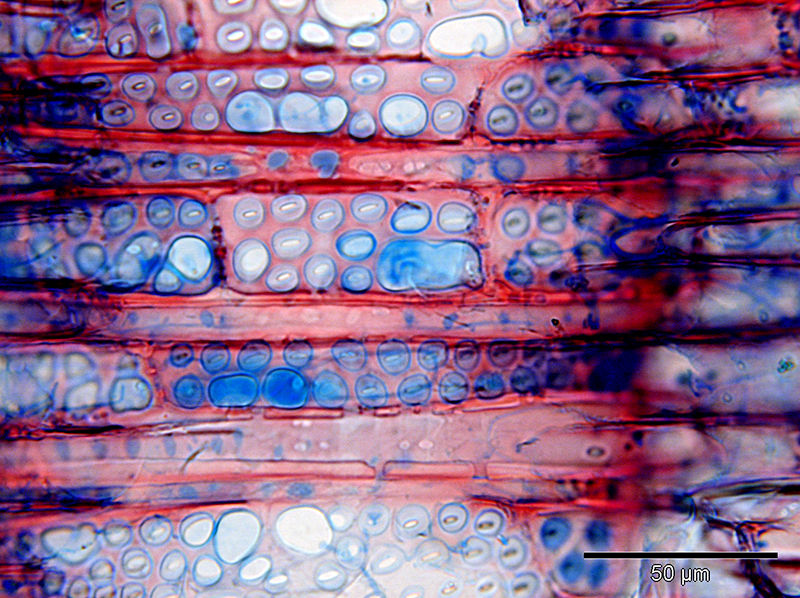
Detailed radial wood section of Cariniana micrantha, a tropical tree with two distinct types of vessel-ray pitting that only occurs in few families.
The role of the International Association of Wood Anatomists
The International Association of Wood Anatomists (IAWA) was founded in 1931 and remains the world’s largest international scientific network of wood scientists, with about 500 members worldwide. IAWA aims to advance research and education in wood science by facilitating knowledge exchange, for example through publishing scientific publications in the IAWA Journal and organising (inter)national congresses supported by regional groups. The Afro-European Regional Group has so far organized five IAWA congresses, in Pretoria (1985), London (1996), Montpellier (2004), Naples (2013), and Tervuren (2015). Johannesburg has recently taken the initiative to organize an IAWA congress in 2026.

Leiden has long played a prominent role in IAWA. The former Rijksherbarium Leiden, later the National Herbarium of the Netherlands (with branches in Leiden, Utrecht, and Wageningen), was for many years a leading center in wood anatomical research.
The Leiden-based wood scientists Pieter Baas and Frederic Lens both served as IAWA Executive Secretary from 1976 to 1981 and from 2011 to 2016, respectively Pieter Baas was also the driving force and Editor-in-Chief of the IAWA Journal from 1980 to 2019. Following the establishment of Naturalis Biodiversity Center, and the integration of the collections of Leiden, Utrecht, and Wageningen, Naturalis now houses the world's second largest scientific wood collection, with around 125,000 samples from all continents.
The IAWA office is still based at Naturalis today. Cees Lut manages membership administration and Ingrid de Kort serves as Treasurer.
Thanks to the merging of all important natural history collections in the Netherlands, Naturalis has now become one of the leading natural history museums in the world, with 43 million objects, 500.000 visitors per year, and about 130 research staff members.
Early Bird registration for IAWA Leiden 2027 is now available!
Don’t miss this opportunity to secure your spot at a reduced rate. Take advantage of the Early Bird offer (until March 15) and join us for an inspiring congress filled with knowledge, innovation, and meaningful connections. Register today and be part of IAWA Leiden 2027!